How To Determine The Value of Your Home
January 19, 2020THE BIGGEST FACTORS THAT AFFECT RE AL ESTATE VALUE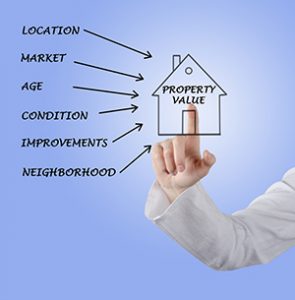
A lot of factors can help predict the price your home will receive when you put if up for sale. Ultimately, it’s worth what a buyer will pay for it….
PROPERTY LOCATION
We’ve all heard the phrase “location, location, location” but what does this mean in practical terms when it comes to property prices?
- Quality of local schools is frequently the single most important factor for buyers with children of school-going age
- Proximity to local employment opportunities is a very high priority for most employment-age buyers
- Proximity to social, shopping and recreational centers is valued most by younger buyers but plays an important role in pricing for all home buyers.
These factors are not independent of one another – many parents want to drop the kids off and pick them up at school as part of a reasonable commute to and from work. These three preferences – proximity to school, work and entertainment/shopping — are a trinity that make for immensely valuable property. Generally, getting a home which has one of the three attributes won’t blow the proverbial roof off the price per square feet. If you’re getting two out of three, one should expect stiff competition and commensurate prices.
UPGRADES AND UPDATES
While some buyers actively seek out fixer-upper properties, most home buyers prefer a house that is move-in ready – and they are willing to pay a reasonable premium for that comfort. A new roof, for example, generally recoups more than 80 percent of it’s value when the home is sold. According to the National Association of Realtors, upgraded kitchens and bathrooms are among the most important upgrades cited by home buyers because they represent a major expense (and headache) if the buyer has to upgrade them.
INSPECTION REPORT
In some hot markets, buyers may forego their right to an inspection report but that’s a risk that most mortgage lenders won’t underwrite. For most buyers, mortgage financing is contingent on a favorable inspection (the banks don’t want to lend you money for a termite farm). Even if a home is under contract, the inspection report can greatly impact the price of the home (usually downwards as the buyer uncovers previously unknown/undisclosed issues that require repairs). The more recommended repairs on the report, the more negotiating room a buyer has. If the deal falls through, the seller must disclose the inspection report to future buyers, further dampening the chance to sell at the original listed price.
Experienced inspectors usually come with Errors & Omissions (E&O) insurance to cover themselves in case of a mistake – the absence of this insurance is a red flag. Using referrals from friends, families and real estate agents and calling references from an inspector’s actual past customers will help you find an inspector you can trust.
NEIGHBORHOOD COMPS
Comparable properties, sometimes called “comps”, sold in your area also impact your own home’s market value. Appraisers and real estate agents look at recent sales of homes with similar features to use as a benchmark against your home’s potential price. Foreclosures and short sales often complicate things because they tend to sell at lower prices, decreasing the neighborhood’s overall average sales price. Comps (along with offer details) are usually the key driver for the appraisal process: most appraisers will rely heavily on recent nearby transactions on homes of a similar size to yours.
APPRAISAL VALUE
The appraisal is the real estate industry’s formal process for pricing a property. All states require appraisers (for any federally regulated lender) be licensed or certified by an organization accredited by the Appraiser Qualifications Board. Whenever a loan is involved in the financing of a property purchase or home equity borrowing, an appraisal is almost always required. Most lenders won’t approve a loan for more than the appraised amount, so if the assessed value falls short the seller either needs to lower the price or the buyer needs to put extra money down to decrease the loan amount. Additionally, if the appraiser deems there is a structural issue such as a faulty roof or termite damage, the bank will not approve the loan until the issues are fixed – most often at the expense of the seller. Appraisers follow a structured process for evaluating the property by looking at recent comparable sales to establish a benchmark price and then adjusting the price up or down according to the upgrades and improvements you have or have not made relative to the comparable properties.
ECONOMIC FACTORS
The strength of the overall economy significantly impacts the real estate market as consumers’ ability to support housing prices largely depends on key factors like unemployment, and income growth. Local trends can outsize national factors in their importance. This gives buyers the ability to spend more on housing, consequently increasing real estate prices.
INTEREST RATES
When people talk about the “Fed interest rate”, they usually mean the Federal Reserve overnight borrowing rate for depository institutions. This is a key factor in how mortgage rates are established because it sets the cost for banks to borrow money. Lower Fed interest rates typically lead to lower mortgage rate offers from banks; this, in turn, decreases the monthly mortgage payments a home buyer must pay for a given mortgage amount. The smaller the monthly payment, the more “affordable” a loan is to prospective home buyers; this fact can increase the size of the mortgage for which home buyers are eligible to get which, in turn, might drive up property prices. The Federal Reserve has hinted at a hike in the federal funds rate by the end of 2019, which should eventually manifest itself as an increase in mortgage interest rates. However, because income and other economic factors continue to strengthen, some experts don’t believe that a rise in Fed interest rates will have a significant impact on residential property prices.
THINKING AHEAD
Real estate prices are deeply cyclical and much of it is dependent on factors you can’t control. Whether you plan on buying a new property or want to use the equity in your home for other expenses, it is important to analyze both broader market conditions and your specific property to determine how the home’s value may fare over the course of time.